
Grief can make people admire your strength while completely missing your exhaustion.
You keep showing up.
You answer the telephone.
You handle responsibilities.
You take care of the family.
You go to work.
You encourage everyone else.
You make decisions when decisions must be made.
People look at you and say, “You are so strong.”
But sometimes you do not want to be strong.
Sometimes you want someone else to carry the weight for a while.
There is a particular kind of loneliness that comes when everyone assumes you are doing well because you have learned how to function while hurting. Your ability to keep going can unintentionally convince others that you no longer need support.
But functioning is not the same as healing.
You can be productive and grieving.
You can smile and grieving.
You can lead and grieving.
You can pray and grieving.
You can encourage someone else while privately needing encouragement yourself.
Strength and sorrow can occupy the same heart.
Sometimes the person everyone depends upon is the person who desperately needs somewhere safe to fall apart.
Perhaps you have become the strong one in your family. When someone dies, everyone looks toward you. You make arrangements. You answer questions. You comfort relatives. You keep things organized. You remember what needs to be done.
And because you are capable, people continue giving you responsibilities.
But somewhere beneath all that strength is a grieving person too.
You lost someone too.
You miss them too.
You have questions too.
You have memories too.
You have moments when you want to cry without explaining why.
You have moments when you do not want to make another decision.
You have moments when you simply want someone to ask, “Who is taking care of you?”
Being strong does not mean being untouched.
Sometimes strength is allowing yourself to admit, “Today is difficult.”
Sometimes strength is asking for help.
Sometimes strength is cancelling something because emotionally you cannot manage it.
Sometimes strength is crying instead of holding everything inside.
Sometimes strength is allowing another person to comfort you instead of always being the comforter.
You do not have to perform strength for people.
Grief does not require you to prove that you can handle everything.
Even Jesus wept.
John 11:35 KJV simply says, “Jesus wept.”
Those two words remind us that tears are not the opposite of strength. Our Saviour openly expressed sorrow. Therefore, you do not have to apologize for yours.
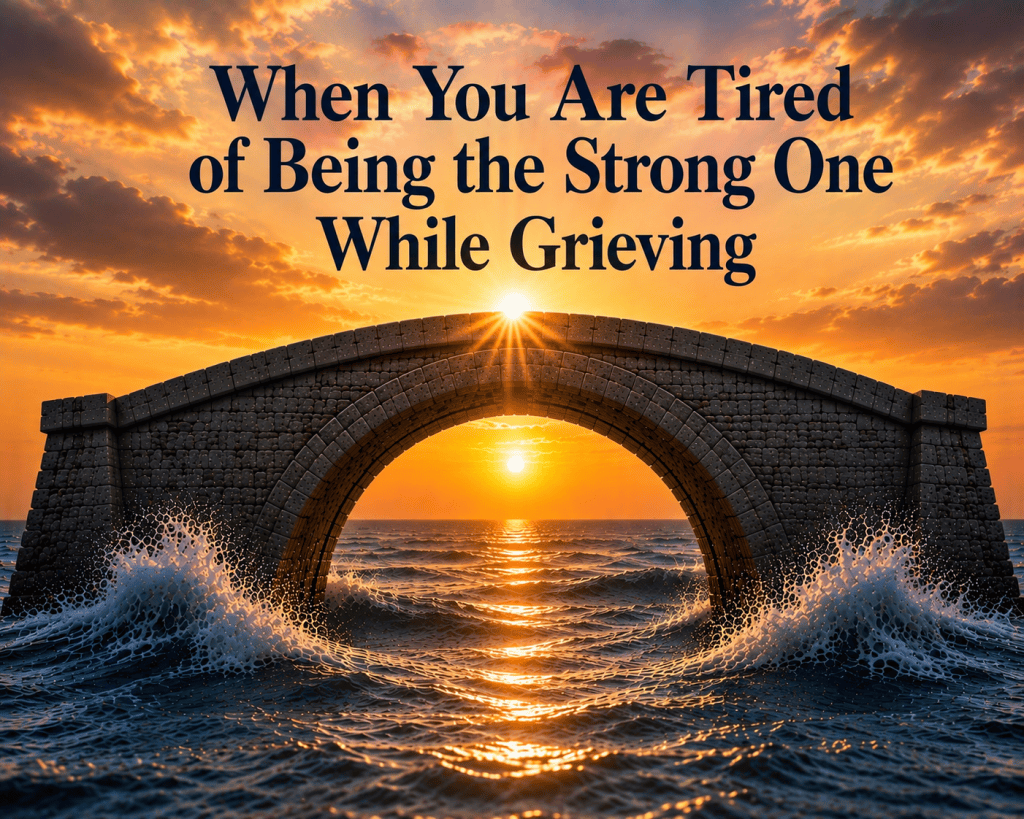
The bridge in Beauty in the Breaking does not remain standing because the waters beneath it are always calm.
The waters move.
The waves rise.
The storms come.
Yet the bridge remains.
Your strength may look like that.
There may be turbulent emotions beneath the surface while everyone sees what appears steady above.
But even bridges require maintenance.
And so do strong people.
You need rest.
You need safe relationships.
You need moments when you are not responsible for everyone else.
You need permission to say, “I need support today.”
You need people who do not only celebrate your strength but recognize your humanity.
And sometimes you need to sit quietly before God and allow Him to carry what you have been carrying for everyone else.
Psalm 55:22 KJV says, “Cast thy burden upon the LORD, and he shall sustain thee.”
Notice that God does not tell you to pretend there is no burden.
He tells you where to put it.
There will be days when you feel strong.
There will be days when you do not.
Both days belong in your healing journey.
You are allowed to need someone.
You are allowed to rest.
You are allowed to cry.
You are allowed to say, “I cannot carry this today.”
And you are allowed to discover that sometimes the strongest thing you can do while grieving is stop trying to be strong for everybody else.
Selah Moment with Dr. Althea Winifred.

