
There are people who cry the moment they receive the news of a loss.
They make the telephone calls.
And then there are those who do not cry at all.
They arrange the funeral.
They comfort the family.
They handle the paperwork.
They make decisions.
They return to work.
They continue serving.
They keep moving.
People admire their composure and say, “You are handling this so well.”
But what others cannot see is that sometimes the heart has not yet begun to process what has happened.
Days pass.
Weeks pass.
Months pass.
Sometimes even years pass.
Then, without warning, something happens.
A familiar song begins to play.
A photograph falls from a book.
Someone mentions a name.
A familiar fragrance fills the room.
And suddenly, the tears come.
Not gently.
Not gradually.
But with an intensity that surprises even the person experiencing them.
And they ask themselves:
“Why am I grieving now when the loss happened so long ago?”
The answer is yes. Grief can be delayed.
Delayed grief occurs when the emotional response to a loss becomes more noticeable or intense some time after the loss itself. This does not mean the person never cared, never mourned, or was unaffected.
Sometimes the full emotional impact simply takes longer to emerge.
When Survival Comes Before Sorrow
There are seasons when life does not allow us much room to stop.
Perhaps you were the eldest child, and everyone depended upon you.
Perhaps you were the spouse who had to make every decision.
Perhaps you were the parent trying to remain emotionally available for your children.
Perhaps you were the minister expected to comfort everyone else.
Perhaps you were the person who had to organize the funeral while privately struggling to accept that the death had actually occurred.
You were functioning because functioning was necessary.
You were managing responsibilities because someone had to manage them.
You were comforting others because they needed comfort.
But somewhere beneath all that activity was a heart carrying a loss it had not fully absorbed.
Sometimes we become so occupied with surviving the loss that we do not recognize how deeply we are grieving it.
The responsibilities eventually decrease.
The visitors stop coming.
The telephone becomes quieter.
The funeral is over.
The paperwork is completed.
Everyone begins returning to normal.
And only then does the silence become loud enough for your emotions to be heard.
You finally have space to feel what you previously had little time to acknowledge.
When Grief Arrives After You Thought You Were Fine
Delayed grief can be confusing because you may have genuinely believed you were coping well.
You attended family gatherings.
You celebrated birthdays.
You traveled.
You worked.
You laughed.
You continued living.
Then something changes.
You begin feeling unusually emotional.
You find yourself missing the person more intensely.
You become sensitive to reminders that previously seemed manageable.
You may experience sadness, anger, regret, loneliness, or emotional exhaustion.
And because so much time has passed, you begin questioning your reaction.
“Why is this affecting me now?”
“Shouldn’t I be over this?”
“Why didn’t I feel this way when it happened?”
But grief does not follow a universal timetable.
There is no emotional deadline that requires sorrow to arrive within a certain number of days.
And there is no rule stating that the deepest emotions must occur immediately after death.
The passing of time does not automatically mean the completion of grieving.
When the Strong One Finally Breaks Down
Sometimes delayed grief is especially noticeable among people who are accustomed to leadership, caregiving, ministry, or responsibility.
They are the people everyone calls.
The people everyone trusts.
The people who know what to do when a crisis happens.
They organize.
They encourage.
They pray.
They provide solutions.
But being capable does not make someone immune to sorrow.
There may come a moment when the strong one finally sits alone and realizes:
“I never really allowed myself to grieve.”
Perhaps they were too busy helping everyone else.
Perhaps they feared that if they started crying, they would not be able to stop.
Perhaps they believed their faith required them to remain composed.
But faith does not prohibit tears.
John 11:35 (KJV) says:
“Jesus wept.”
Two words that reveal something profoundly important.
Sorrow is not a failure of faith.
Tears are not evidence of spiritual weakness.
Even when we trust God, we can experience deep emotional pain.
And sometimes that pain emerges long after everyone assumes we have healed.
When Another Loss Awakens the First
One of the most powerful triggers of delayed grief is experiencing another loss.
You may have lost your mother years ago and believed you had adjusted to life without her.
Then your father dies.
Suddenly, you find yourself grieving both parents.
You may have lost a sibling and continued functioning for years.
Then another sibling dies.
And the grief you thought had settled rises again.
You are no longer mourning only the most recent death.
You are remembering every absence.
Every funeral.
Every goodbye.
Every relationship that death has changed.
Sometimes a new loss opens emotional doors that have remained closed for years.
This does not mean your earlier healing was false.
It means grief can be reawakened by experiences that connect with previous losses.
Grief does not always return one memory at a time. Sometimes it brings an entire history of love and loss with it.
The Bridge Between Delayed Grief and Healing
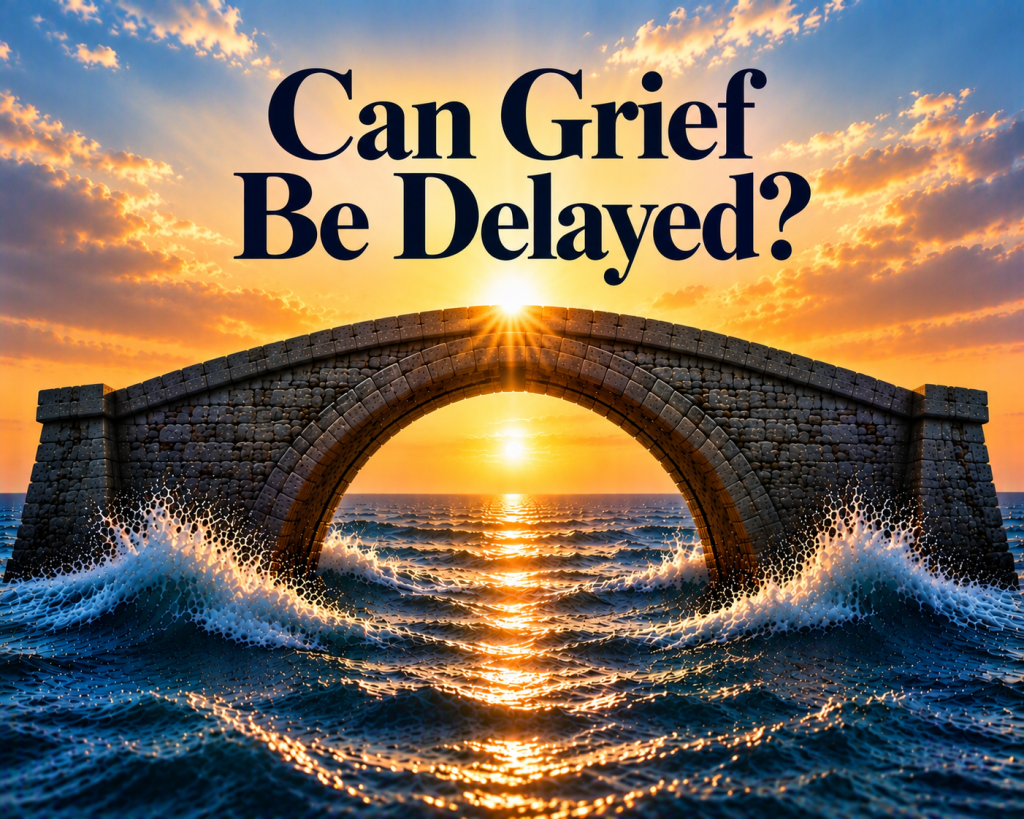
The bridge in Beauty in the Breaking represents the journey between loss and learning how to live with what has changed.
The waters beneath the bridge are not always calm.
Sometimes they move quietly.
Sometimes they rise unexpectedly.
Sometimes a wave reaches a place that has remained untouched for years.
Delayed grief can feel like one of those unexpected waves.
You thought the storm had passed.
You thought the waters had settled.
You thought you had already crossed the most difficult part.
Then another wave arrives.
But remember:
An unexpected wave does not mean the bridge has collapsed.
It does not mean you have failed.
It does not mean you are beginning your healing journey all over again.
It means there may be another dimension of your loss that needs compassion, acknowledgment, and care.
Healing is not always about removing every emotional response.
Sometimes healing means allowing yourself to experience what you were previously unable to process.
Give Yourself Permission to Grieve Now
If your grief has arrived months or years after your loss, you do not have to apologize for its timing.
You do not have to justify your tears.
You do not have to explain why a memory suddenly hurts.
You do not have to pretend that you are unaffected because everyone else believes you should have moved on.
Allow yourself to acknowledge what you feel.
Talk about the person you lost.
Share the memories.
Write about your experience.
Pray honestly.
Reach out to someone you trust.
And if the grief becomes overwhelming or significantly interferes with your daily life, consider speaking with a qualified grief counselor or mental health professional.
Seeking support is not an admission of defeat.
It is an acknowledgment that your emotional well-being matters.
Ecclesiastes 3:4 (KJV) reminds us:
“A time to weep, and a time to laugh; a time to mourn, and a time to dance;”
Sometimes the time to weep comes much later than we expected.
And that is okay.
You may not have cried at the funeral.
You may not have broken down during the first anniversary.
You may have continued living for years before realizing how deeply the loss affected you.
But your grief is no less real because it arrived later.
Your love is no less meaningful because your tears were delayed.
And your healing is no less valid because your emotions did not follow the timetable others expected.
Perhaps the most important thing to understand is this:
Delayed grief is not necessarily grief denied. Sometimes it is grief that becomes fully felt when the heart finally has the space to acknowledge its sorrow.
The loss may have happened years ago.
The tears may have arrived today.
But both deserve compassion.
The waters may have been quiet for a long time.
Now they are moving again.
And the bridge remains.
You can continue crossing.
Not according to someone else’s timetable.
Not according to society’s expectations.
But with patience, grace, and permission to experience your grief as it unfolds.
Because grief may be delayed, but healing is still possible.
Selah Moment with Dr. Althea Winifred.

