
One of the most surprising parts of grief is discovering how deeply the smallest things can affect you.
A scent drifting through the air.
A familiar song playing unexpectedly.
A certain meal.
A phrase someone says in passing.
And suddenly, without warning, your heart feels heavy again.
These are grief triggers.
They are the moments when memory and emotion collide unexpectedly. A trigger can transport you back to a person, a place, or a season of life in an instant. What seems ordinary to others may carry profound meaning to you.
Grief stores itself in details.
The mind remembers facts, but the heart remembers experiences. It remembers how someone laughed. It remembers the sound of their footsteps. It remembers the atmosphere of moments once shared.
Because of this, grief can surface in places you least expect.
You may be standing in line at a grocery store and suddenly remember the snacks someone used to buy. You may smell a certain perfume or cologne and instantly feel emotion rising within you. You may hear a familiar hymn, a favorite song, or even a particular phrase, and suddenly the ache returns.
Triggers are powerful because they awaken connection.
For many people, these moments feel frustrating. You may think, “I was doing okay—why am I crying now?” You may wonder why something so small has such a strong effect on you.
But grief is not measured by logic.
It is measured by love.
The smallest trigger can carry the weight of years of memories. What seems insignificant on the surface may hold deep emotional meaning underneath.
Some triggers are obvious. Anniversaries, birthdays, holidays, and special dates often stir grief because they mark moments connected to the loss. But other triggers are subtle and unexpected.
A chair left empty.
A voicemail saved on a phone.
A handwriting sample.
The silence after reaching for someone who is no longer there.
These moments can feel like emotional ambushes.
But they are also reminders that love leaves impressions on the heart.
Over time, you begin to understand your triggers rather than fear them. You begin to recognize that they are not signs that you are “failing” at healing. They are signs that certain memories still carry emotional significance.
Healing does not erase emotional connection.
It teaches you how to live with it.
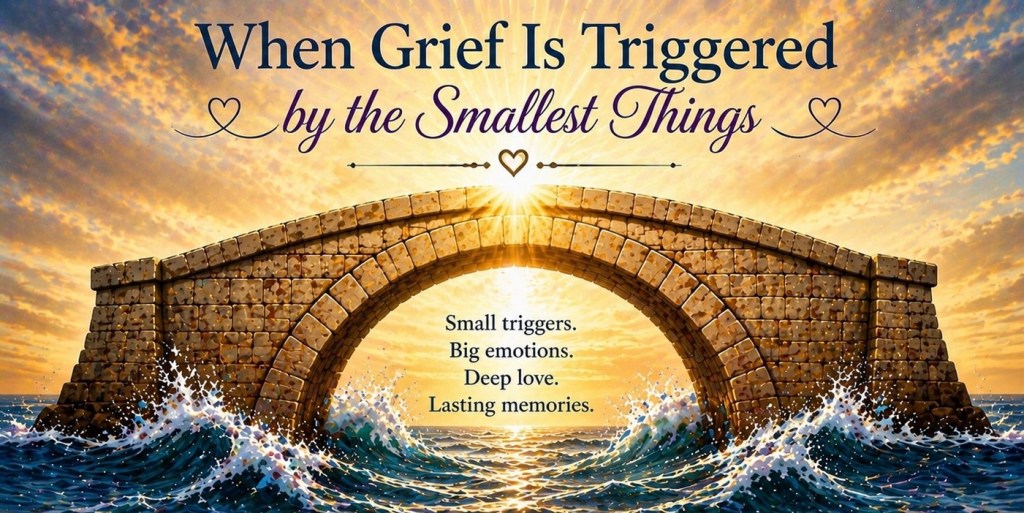
The bridge in Beauty in the Breaking reflects this journey beautifully. The waves beneath the bridge are constantly moving, just like the emotions that grief triggers can awaken. Some waves are small and manageable. Others arrive unexpectedly and feel stronger.
Yet the bridge remains steady.
You begin to realize that even when triggers come, they do not have the power to destroy your healing. They may stir emotion, but they also remind you of the depth of love you experienced.
And love that mattered deeply will always leave traces behind.
With time, many triggers begin to soften. The memories attached to them may still bring emotion, but not always the same intensity of pain. What once caused overwhelming sorrow may eventually bring reflection, tenderness, or even gratitude.
This does not mean the loss mattered less.
It means your heart is learning how to carry the memory differently.
Grief triggers are not interruptions to healing.
They are part of the process of remembering, loving, and slowly learning how to move forward while still honoring what was meaningful.
The trigger may last a moment.
But the love behind it lasts far longer.
Selah Moment with Dr. Althea Winifred.

